

Before you add oral fluid to a DOT testing program, decide which tests would use it and what the collector should do when a collection cannot proceed as planned. Your policy, test orders and collection-site instructions need to agree.
An employer can generally keep using urine testing when oral fluid becomes available. A specific exception applies to certain directly observed collections, so a general urine fallback needs to account for that requirement.
As of October 13, 2026, DOT’s published laboratory and device list still shows no HHS-certified oral fluid laboratories. DOT requires at least two before employers can begin using oral fluid in the DOT program. For now, continue using urine for DOT drug tests while preparing any future changes. The FDA’s October 6 final order changed test-system requirements. It does not exempt oral fluid collection devices or authorize DOT oral fluid testing by itself.
1. Set the specimen choices in your policy
Read the sections that identify the specimen type, testing reasons, and collection procedures. If the policy says tests will use urine, revise that language before introducing oral fluid. An employer may choose different specimens for different testing reasons. You do not have to replace every urine test with oral fluid. You might retain urine as the usual specimen and authorize oral fluid for particular situations once it is available. Under 49 CFR 40.210, the employer chooses the specimen type. The employee does not choose upon arriving at the collection site. Do not order urine and oral fluid simultaneously at the beginning of the same testing event.
Directly observed urine collections need separate instructions. Under 49 CFR 40.67(g)(4)-(6), oral fluid is required when a same-sex observer cannot be found, subject to the rule’s availability and transition conditions. Availability requires two HHS-certified laboratories, a qualified oral fluid collector, and a conforming collection device at a collection site.
The directly observed collection exception
An 18-month grace period begins when HHS gives notice of the second certified laboratory. DOT will publish the period’s start and end dates. During that period, employers may continue directly observed urine collections until they are set up for oral fluid. An employer that has decided to use oral fluid and is ready must use it in the observer-unavailability situation.
For that required oral fluid collection, the DER must arrange another acceptable oral fluid site if the current site cannot perform it. Before oral fluid is available, the DER must arrange a same-sex observer or another acceptable site for the required observed urine collection. Your general urine fallback must account for this exception.
Keep the DOT portion of the program separate from any non-DOT testing. 49 CFR 40.13 requires that separation. A collection site’s ability to offer non-DOT oral fluid testing does not establish that it can perform a DOT oral fluid collection.
For each testing reason covered by your program, decide:
- The specimen normally requested.
- Whether an alternative is authorized if the requested collection is unavailable.
- What to do when an insufficient specimen requires another collection.
- How required direct observation will be handled.
Review these decisions with your testing administrator. Have employment counsel review the policy changes and any applicable collective bargaining obligations before implementation.
2. Give the collector written instructions
A standing order is a written collection protocol that communicates the employer’s instructions to its third-party administrator and collection sites. It can identify the usual specimen for each testing reason and explain what to do when the collection cannot proceed as planned.
DOT does not require every employer to use one universal standing-order form. Its oral fluid collection guidelines describe standing orders as a best practice. The requirement is to give collectors the information they need. 49 CFR 40.14 includes the specimen type among that information. A written protocol lets the collector find the employer’s instructions without calling for a new decision at every collection. The protocol should agree with your policy, the test order, and the instructions held by your administrator.
Include the following in the standing order or accompanying collection paperwork:
- Employee identification: full name and the identifier required for the testing program. A Social Security number is not universally required.
- Employer details: name, address, phone number, and fax number.
- Program details: the regulating DOT agency and test reason.
- Collection instructions: specimen type and whether direct observation is required.
- Laboratory details: name and address. Medical Review Officer details: name, address, phone number, and fax number.
- DER contact: the Designated Employer Representative’s name and telephone number, so the collector can reach the employer about a problem.
At WorkSAFE, we use Social Security numbers when requested, but more often use an employee ID or CDL information. Apply the rules for the program being tested. 49 CFR 40.14 lists an SSN or employee ID. For FMCSA testing of CDL or commercial learner’s permit (CLP) holders, use the driver’s CDL or CLP number and issuing state as applicable, rather than substituting an SSN or internal employee ID. FMCSA identification guidance.
The employee-specific information will change with each order. The specimen-selection instructions can remain on file. Section 40.36 requires employers to provide the DER’s name and telephone number to collectors; provide a current contact when you prepare the collection.
If a collection problem requires a second collection and no standing order applies, the collector should contact the DER for the specimen decision. Section 40.210 permits a service agent to choose the alternative when there is no standing order and the service agent cannot reach the DER. That exception applies to completing a testing event when a collection problem necessitates another collection.
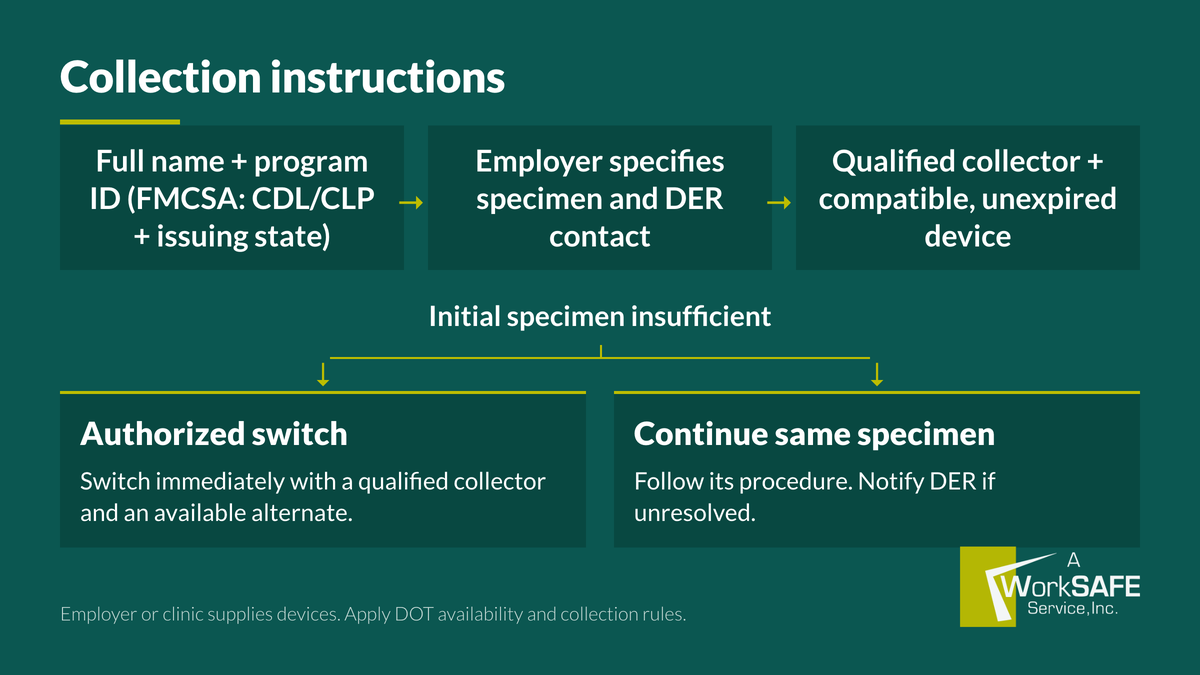
Collection instructions
- Full name + program ID (FMCSA: CDL/CLP + issuing state)
- Employer specifies specimen and DER contact
- Qualified collector + compatible, unexpired device
Initial specimen insufficient
- Authorized switch
Switch immediately with a qualified collector and an available alternate.
- Continue same specimen
Follow its procedure. Notify DER if unresolved.
Employer or clinic supplies devices. Apply DOT availability and collection rules.
The flowchart in words:
- Give the collector the employee’s full name and program-specific identifier, along with the test reason, specimen type and DER contact. For FMCSA testing, use the applicable CDL or CLP number and issuing state.
- Confirm that the collector is qualified and the required supplies are available. For oral fluid, confirm a compatible, unexpired device and agree whether the employer or clinic will supply it.
- If the initial specimen is insufficient, follow the employer’s instructions at that point. An immediate switch requires a qualified collector and an available alternative. Otherwise, continue the applicable procedure for the same specimen type.
3. Decide how to handle an insufficient specimen
Decide this before the collection. Under 49 CFR 40.193(a), an employee who does not provide enough specimen must have another opportunity. Following the employer’s instructions, that can use the same specimen type or an alternative collected by someone qualified to collect it. Write the switch decision for the point when the initial attempt produces an insufficient specimen. The employer’s instruction should determine whether the collector continues the insufficient-specimen procedure or switches immediately. Do not write a protocol that starts a waiting period and then arbitrarily changes specimen types 30 or 60 minutes later.
A switch also needs to be workable. If your instructions allow urine to oral fluid, the site needs a qualified oral fluid collector and the correct device. If they allow oral fluid to urine, it needs a qualified urine collector and urine collection supplies. The alternative must be available for DOT use.
If the collection stays with the same specimen type, the Part 40 procedures provide up to three hours for insufficient urine and up to one hour for insufficient oral fluid. These periods end earlier if the employee provides enough specimen. The collector follows the applicable fluid, waiting, and documentation instructions; the employee’s decision not to drink fluids is not, by itself, a refusal to test.
Document a switch and complete the required follow-up
When an authorized alternate collection begins, section 40.193(a) requires a new Federal Custody and Control Form, or CCF, with a remark documenting the change. The collector discards the insufficient specimen and its CCF under that procedure. The new collection follows the starting procedures for the new specimen type.
If the employee still cannot provide enough specimen by the end of the applicable period, the collector stops the collection, records what happened, and immediately notifies the DER. The DER must consult the Medical Review Officer and direct the employee to obtain a medical evaluation within five days. The licensed physician must be acceptable to the MRO and have expertise in the medical issues raised by the specimen problem. The evaluation addresses the final specimen type attempted. Do not treat an insufficient specimen alone as an automatic refusal; section 40.193 sets out the evaluation and determination process.
4. Confirm that the collection site can carry out the order
A policy can authorize a future option before every collection site is equipped to provide it. Confirm readiness before sending the employee. Oral fluid collection requires a separate qualification from urine collection. 49 CFR 40.35 requires oral fluid qualification training and five consecutive error-free mock collections for each device the collector will use. A person qualified to collect urine is not automatically qualified to collect oral fluid. Employers and administrators can request documentation showing that the collector meets the oral fluid requirements.
The device must also match the laboratory. DOT’s laboratory and device list identifies the device approved for each certified laboratory. Once DOT oral fluid testing becomes available, verify the actual laboratory and device combination before using it. The employer may supply the device, or the clinic may supply it. Agree on that arrangement in advance and confirm that a compatible device will be at the site when needed. 49 CFR 40.72 prohibits using a device after its expiration date.
Include a fallback for a site that cannot provide the requested collection. For ordinary specimen choices, you can authorize urine when a site lacks oral fluid capability, if that fits your policy and instructions. This fallback does not replace a required oral fluid collection under section 40.67(g)(4)-(6). Confirm the appropriate collection site with your administrator before the employee travels.
Part 40 requires laboratory testing. Section 40.210 does not authorize instant or point-of-collection drug tests for the DOT program. Buying an oral fluid kit does not establish a DOT testing program.
5. Put the final instructions into use
Explain the specimen choices to employees before introducing them. Tell them which situations may use oral fluid, who decides, and what to expect if they cannot provide enough specimen. Include any agreed changes for a unionized workforce in that preparation.
Give your administrator and collection sites the final protocol. Ask them to confirm that it is on file and that the people handling orders can find it. Make the specimen type clear on each test order. Review any electronic ordering settings so they agree with the written instructions. Keep the policy and collection protocol together when you revise the program. An old order can still request urine after a policy allows oral fluid, or omit the fallback you intended. Checking the order against the protocol is a practical way to identify that mismatch before the employee arrives.
You can prepare the policy now without introducing oral fluid into DOT testing today. Decide where you want the option, write the collection instructions, and confirm readiness when the federal requirements are met.
A WorkSAFE Service helps employers develop testing policies and collection instructions. Employers can review our policy development services for help working through specimen choices and standing orders for their program.
Watch the oral fluid webinar
This September 23, 2026 recording predates the October 6 FDA order. The availability and regulatory updates in this article were checked October 13, 2026.
