
The short answer: for one to three employees, the nearest clinic is usually the cheaper choice. At four or more people at one location, the paid time employees spend driving, waiting and returning to work often costs more than bringing a collector to the site. Multiply the number of employees by the hours each spends away and by their loaded hourly cost, then compare that with the cost of an onsite event. This article shows the math with real numbers.
For an employer with one person who needs a test, sending that employee to a nearby clinic may be the obvious choice. When four, eight, or 20 employees need testing at the same location, the economics can look very different.
For A WorkSAFE Service, four employees at one location are a practical starting point for considering an onsite testing event. That is not a universal break-even number. The real answer depends on how much employee time is lost going to a clinic, labor costs, the distance to the clinic, clinic wait times, the number of employees being tested, and the cost of bringing a collector to the worksite.
This article addresses both Federal DOT drug and alcohol testing and employer-authorized non-DOT testing in Oregon and Washington. Employers with DOT-regulated employees need to keep DOT and non-DOT testing properly classified and administered as separate programs.
What Does an Offsite Drug Test Really Cost an Employer?
The price of the test itself does not tell you the full cost of sending an employee to a clinic.
If the test costs the same whether it occurs onsite or at a clinic, the important variable becomes what happens to the employee's work time.
Based on A WorkSAFE Service's operational experience, even when a clinic is only about a 10-minute drive away, an employer can reasonably expect an employee to be away from work for at least 45 minutes when everything goes smoothly.
That estimate includes travel, check-in, collection and returning to work. It can take considerably longer when:
- The clinic is busy.
- The employee cannot immediately provide a sufficient urine specimen.
- Travel takes longer than expected.
- The collection site is more than 10 minutes away.
- Several employees have to make separate trips.
For employers paying drivers, pipeline workers, transit employees or other skilled workers while they are away from productive work, those minutes add up.
How Do You Calculate the Cost of Sending Employees to a Clinic?
Consider a hypothetical employer with 10 employees who need testing.
Assume each employee has a fully loaded labor cost of $40 per hour and spends 45 minutes away from work.
The basic lost-time calculation is:
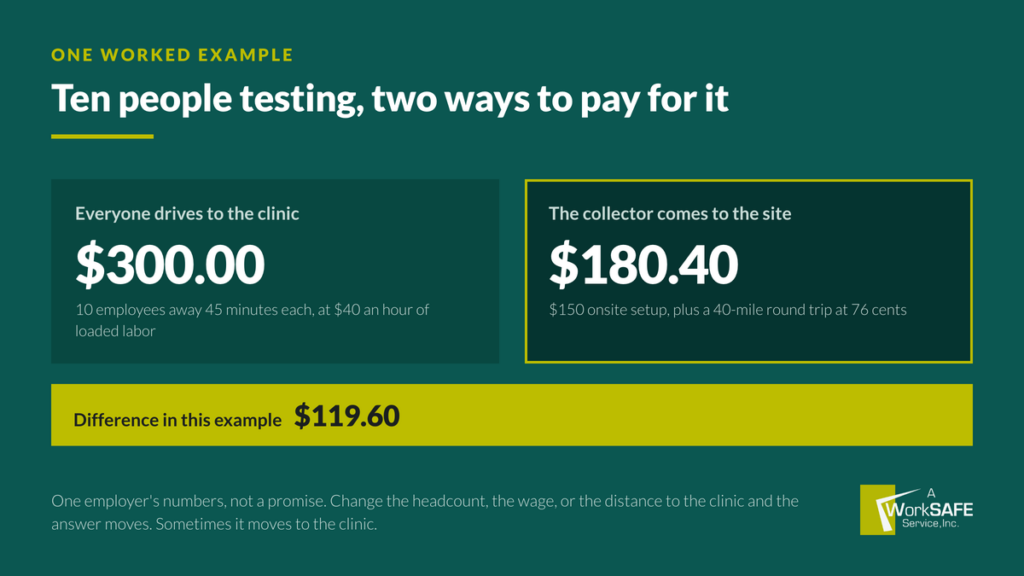
10 employees × 0.75 hours × $40 per hour = $300
That is $300 in labor time before accounting for employer vehicle expenses, fuel, mileage, scheduling disruption, administrative time or the possibility that some clinic visits take longer than 45 minutes.
Now consider 20 employees:
20 employees × 0.75 hours × $40 per hour = $600
If the average trip takes an hour instead:
20 employees × 1 hour × $40 per hour = $800
That is why the headcount matters so much. Every additional employee sent away from the worksite multiplies the employer's lost-time cost.
A useful planning formula is:
Offsite cost = number of employees × average hours away × hourly labor cost + other travel/operational costs
Employers can substitute their own numbers instead of relying on a generic industry estimate.
When Does Onsite Testing Become the Better Financial Choice?
A WorkSAFE Service generally recommends evaluating onsite testing when four or more employees at the same location need to be tested.
The financial comparison is relatively straightforward because the cost of the individual test usually does not change based simply on whether A WorkSAFE Service performs it onsite or sends the employee to a collection site.
For an onsite event, A WorkSAFE Service currently charges a $150 onsite setup fee per event at each location, plus round-trip mileage at the applicable mileage rate. Individual testing charges still apply.
For example, suppose an onsite event involves a 40-mile round trip. Using the July-December 2026 76¢-per-mile rate:
40 miles × $0.76 = $30.40
Adding the onsite setup fee produces an illustrative onsite-event expense of:
$150 + $30.40 = $180.40
Compare that with our hypothetical 10-person workforce losing $300 in labor time on 45-minute clinic visits.
The same 10-person testing event | Cost |
|---|---|
Clinic visits: 10 employees × 45 minutes × $40 per hour | $300.00 |
Onsite event: $150 setup fee + 40 miles at 76¢ | $180.40 |
Difference in favor of onsite | $119.60 |
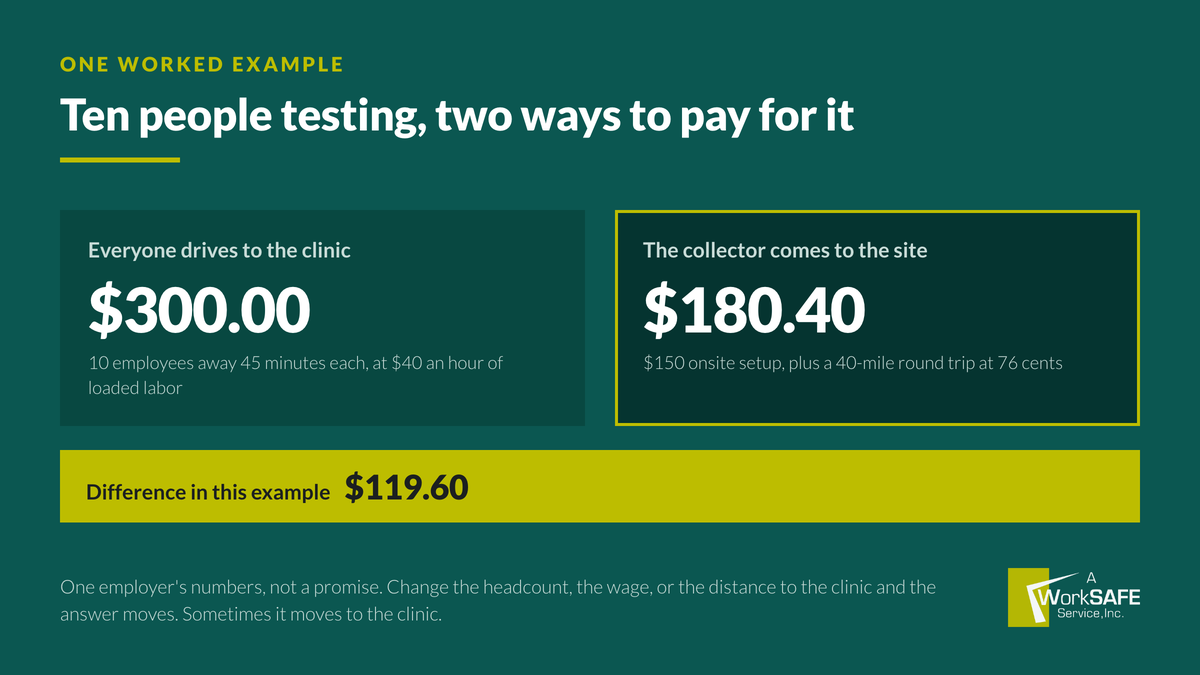
This simplified example excludes paid employee time spent completing the onsite collections. Include that time in a full cost comparison.
The difference in this simplified example is $119.60 in favor of onsite testing, even before assigning a value to vehicle costs, administrative disruption or unexpected clinic delays.
The point is not that onsite testing will always save $119.60. It won't. The example shows employers how to run the calculation using their own workforce.
Why Can Four Employees Be an Important Threshold?
Consider the same $40-per-hour labor assumption for four employees.
If each employee loses 45 minutes:
4 × 0.75 × $40 = $120 in labor time
At that point, lost labor time alone may not cover the $150 onsite setup fee, much less collector mileage.
But change one variable and the calculation changes quickly.
If those four employees each lose an hour and a half because the collection site is farther away or the clinic has a wait:
4 × 1.5 × $40 = $240
Now onsite testing may make considerably more financial sense.
This is why employers should not ask only, "How many people are we testing?"
A better question is:
How many paid employee-hours will we lose if everyone has to leave the worksite?
When Does a Clinic Make More Sense?
Onsite testing is not automatically the most efficient choice.
Preemployment testing is a good example. When applicants are being hired individually, sending them to a collection site allows each applicant to complete testing at a convenient time without requiring an employer to organize an onsite event.
A job fair or large group of new hires can change that equation. If several applicants need testing at the same place and time, an onsite event may become practical.
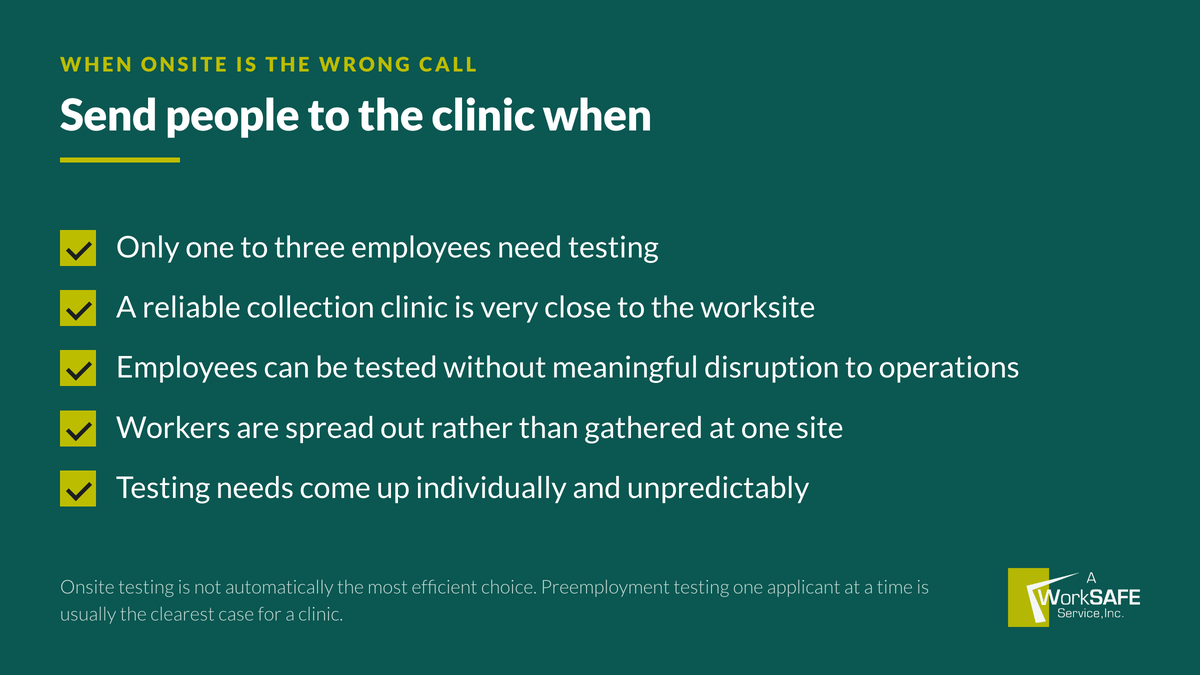
Clinics can also be the better option when:
- Only one to three employees need testing.
- A reliable collection clinic is very close to the worksite.
- Employees can be tested without meaningful disruption to operations.
- Workers are geographically dispersed rather than gathered at one site.
- Testing needs occur individually and unpredictably.
Post-accident situations require another consideration. If an employee also needs medical evaluation or treatment after an accident, an occupational health clinic may be the more appropriate destination. Employers should not allow the convenience of drug or alcohol testing to interfere with needed medical care.
Why Are Random Testing Events Well Suited to Onsite Collections?
Random testing is one of the most common reasons A WorkSAFE Service conducts onsite events.
The operational advantage is concentration: an employer can test several selected employees at the same worksite rather than sending workers to a clinic one at a time.
Timing the event around a shift change can make that even more efficient.
For example, a collector may arrive shortly before one shift ends and another begins. Employees coming off duty and employees reporting for work can then be available during the same collection event.
This can be particularly useful for transportation, pipeline, maritime and other operations where employees work defined shifts or where sending several workers away from their assigned location would interfere with operations.
Onsite collections can also shorten the interval between notification and collection and reduce opportunities for employees to alter their normal routine after learning of a random selection.
The employer's actual policy and applicable testing requirements still control who is tested, why they are tested and how the selection and collection must be conducted.
What About Remote Jobsites and Multiple Locations?
Distance can make the onsite calculation even more compelling.
A WorkSAFE Service supports scheduled mobile and onsite employer testing throughout Oregon and Washington, subject to advance scheduling and availability.
This can be useful for employers operating remote jobsites or managing employees at multiple locations throughout the state. Instead of directing several workers from a project to the nearest available clinic, an employer can evaluate whether moving the collector is more efficient than moving the workforce.
Maritime operations offer another example. When several workers aboard or associated with a larger vessel need testing, bringing collection capability to the workforce can solve a logistical problem that is not captured by the price of an individual test.
The same principle applies elsewhere: the harder it is to move employees without interrupting operations, the more valuable onsite collection may become.
What Does an Employer Need to Provide for Onsite Testing?
Many employers assume they need a dedicated medical or testing facility. They generally do not.
For an onsite urine-testing event, A WorkSAFE Service prefers access to a standalone restroom where the collection environment can be appropriately controlled. That can include limiting access to water and removing or securing cleaning products and potential hiding places that could interfere with specimen integrity.
A suitable collection area also needs to support the privacy and integrity of the testing process.
When a worksite does not have an appropriate space, A WorkSAFE Service can provide a mobile unit for an additional fee, subject to scheduling and availability.
Does Choosing Urine or Oral Fluid Change the Onsite Decision?
Both urine and oral-fluid drug testing can be performed onsite within A WorkSAFE Service's approved non-DOT service scope.
But specimen choice should generally be made as part of the employer's overall testing-program and risk assessment, rather than simply because the collection will occur onsite.
Urine and oral fluid answer somewhat different testing questions and have different collection and detection characteristics. A routine drug-test result generally establishes whether a specified drug or metabolite was detected at or above the program's cutoff in the specimen. It does not, by itself, establish current impairment, an exact time of use or fitness for duty.
Employers should therefore decide what specimen and testing methodology fit the program first, and then determine whether collecting that specimen onsite makes operational sense.
A Simple Onsite-versus-Clinic Decision Test
Before scheduling the next testing event, calculate five things:
- How many people need testing at the same location?
- How long will each person realistically be away from productive work if sent to a clinic?
- What does an hour of that employee's time actually cost the organization?
- How much operational disruption will occur when employees leave the site?
- What will it cost to bring the collection to the employees instead?
For A WorkSAFE Service clients, four or more people at one location is a useful point to start running those numbers.
Sometimes the calculation will favor onsite testing. Sometimes it will show that the nearby clinic is cheaper and easier.
That is the goal of the calculation: not to prove that onsite testing is always better, but to identify which option actually costs the employer less.
The Employer's Main Takeaway
The cost of workplace drug testing is not just the invoice for the test.
For employers with multiple employees who need testing, the larger expense can be paid time spent driving, waiting and returning to the job, especially when the collection site is distant, workers are highly utilized or operations cannot easily absorb multiple employees leaving at once.
Onsite testing becomes worth evaluating when those lost employee-hours begin to exceed the cost of bringing the collector to the workforce.
A WorkSAFE Service provides scheduled mobile and onsite occupational drug and alcohol testing throughout Oregon and Washington, subject to advance scheduling and availability. Contact A WorkSAFE Service to discuss whether clinic, mobile or onsite testing makes the most operational sense for your next testing event. Every call and email gets an answer within two business hours, and every client works with one dedicated account manager.
Frequently Asked Questions
How many employees do I need before onsite drug testing makes sense?
There is no universal number. A WorkSAFE Service uses four employees at one location as a practical point to start evaluating onsite testing, but labor costs, travel time, clinic availability and mileage can move the financial break-even point higher or lower.
Is onsite testing always cheaper than using a clinic?
No. For one to three employees, individual preemployment tests, or workers located very close to a reliable clinic, clinic collection may be more efficient.
Can random drug testing be conducted onsite?
Yes, a DOT random program or an employer-authorized non-DOT random program may use onsite collections when the program is lawful and the employer's policy provides for the testing. Union, public-employer, state-law and other requirements can affect whether and how random testing may be used.
Can oral-fluid testing be performed onsite?
Yes. A WorkSAFE Service offers urine and oral-fluid options for employer-authorized non-DOT programs within its approved service scope. The specimen should be selected based on the needs and risks of the overall testing program, not merely because testing occurs onsite.
Does a positive onsite drug test prove the employee was impaired?
No. Drug detection and impairment are different questions. A test generally establishes whether the relevant analyte was detected under the test's methodology and cutoff. Screening, confirmation, medical review and the employer's policy also need to be distinguished before an employment decision is made.
About this article
This article provides general compliance information and is not legal advice. Workplace testing requirements depend on the employer, position, testing reason, policy, collective bargaining obligations, and current Oregon, Washington, and federal law. Employers should obtain qualified legal advice for decisions involving discipline, termination, accommodation, or disputed test results.
